
OCC vs Cypress Sonography Programs
Published
Orange Coast or Cypress: Compare the Route, Not Just the Name
Orange Coast College in Costa Mesa and Cypress College in Cypress offer public-college routes into diagnostic medical sonography. For a Southern California student living at home, both deserve serious consideration, but they are not interchangeable admissions processes. OCC describes first-come/first-served selection through its Allied Health process, refined by the catalog's program-ready-date rules. Cypress publishes a ranked 150-point system with an eighty-five-percent rank-list and fifteen-percent lottery allocation. “I have completed my science classes” is not enough to know where you stand in either system.
The comparison below was verified against current college pages, the 2026–2027 OCC catalog, Cypress's current application page and workshop handout, the independent CAAHEP directory, and the current ARDMS prerequisite document on October 13, 2026. It explains prerequisites, grades, documentation, curriculum, clinical commitments and transparent cost assumptions. Where college pages contradict each other, that conflict is identified. Unpublished wait times, prior cutoff scores, acceptance odds and guaranteed clinical-site assignments are not guessed.
This is a decision guide, not a ranking that declares one school universally better. Your transcript, catalog rights, resident status, travel constraints, family responsibilities and available financial support can change the better choice. A student with excellent grades but no qualifying experience may evaluate Cypress differently from an applicant whose OCC program-ready requirements are nearly complete. A short campus commute can also become a longer clinical commute once placements begin.
Contents and Comparison at a Glance
Accreditation and ARDMS · OCC prerequisites · Cypress prerequisites · Admissions · Curriculum · Costs · Decision checklist
| Question | Orange Coast College | Cypress College |
|---|---|---|
| Location | Costa Mesa | Cypress |
| Published educational route | Diagnostic Medical Sonography A.S. | DMS curriculum/associate-degree route; independent directory also lists a certificate award |
| Cohort program length | Published 22 months: four semesters, summer and intersession | Published fall–spring–summer–fall–spring sequence, preceded by conditional summer introduction |
| Admissions method | First-come/first-served description, with counselor-assigned program-ready date in catalog | 150-point rank system; 85% rank list and 15% lottery |
| Capacity | Maximum 24, subject to qualified clinical spaces | Dependent on approved clinical capacity; no current fixed number verified here |
| Prerequisite grade floor | Fall-2026-and-later B in anatomy/physiology and terminology; C in required math | C in stated application prerequisites/GE; DMS 160 timing and B expectation require current confirmation |
| Application timing | Application through required ALH A010 and readiness process; annual fall cohort | Online application during February; notification no later than May 1 |
| Independent DMS concentrations | Abdominal-Extended and Obstetrics/Gynecology | Abdominal-Extended and Obstetrics/Gynecology |
| Published program cost | Approximately $6,000, not a complete individualized living-cost quote | No directly comparable current all-in figure verified; build from units, fees and actual supplies |
| Wait/cutoff odds | Not published in verified sources | No verified historical cutoff or acceptance probability |
Accreditation, Concentrations and ARDMS Eligibility
The colleges state CAAHEP accreditation, but this guide also independently checked the CAAHEP program directory rather than relying only on a college logo. The current directory data lists OCC's Associate in Science in Diagnostic Medical Sonography with Abdominal-Extended and Obstetrics and Gynecology concentrations. It lists Cypress's A.S. and DMS certificate with the same two concentration areas. The award listings do not prove that every applicant can choose either award under current college graduation rules; ask the college about the route applicable to your existing education.
| Independently verified directory entry | Concentrations | Boundary |
|---|---|---|
| OCC DMS Associate in Science | Abdominal-Extended; Obstetrics and Gynecology | Do not confuse OCC's separate cardiovascular program with its DMS degree |
| Cypress DMS Associate in Science | Abdominal-Extended; Obstetrics and Gynecology | The DMS listing is not a promise of every cardiac or vascular concentration |
| Cypress DMS certificate | Obstetrics and Gynecology; Abdominal-Extended | Directory award existence is not an individual admission or GE waiver decision |
CAAHEP is a programmatic accreditor, not ARDMS. JRC-DMS participates in the sonography accreditation review/recommendation process. Institutional accreditation addresses the college as an institution; programmatic accreditation addresses the particular program and concentrations. Those distinctions matter if a school offers several health programs, if a website mentions “ultrasound” broadly, or if a certificate is offered within an otherwise accredited college.
For qualifying graduates, the current ARDMS prerequisite document describes the accredited-program Pathway 2. That route normally does not require an additional postgraduation year of clinical experience, because the program supplies the qualifying training. Application documents still matter, and accreditation is not retroactive. Students whose directors participate in the paperless process may apply up to sixty days before graduation, subject to successful completion.
Graduating does not automatically award RDMS. The relevant examination requirements, eligibility documentation, SPI/specialty pairing and passing results still apply. A program's abdominal and OB/GYN concentrations naturally support study in those areas; introductory vascular coursework is useful but does not convert the DMS program's listed concentrations into a separately verified vascular accreditation. Ask about your intended specialty and clinical verification rather than assuming any course title guarantees any credential.
CAAHEP graduation is not the only ARDMS pathway. Other routes address qualifying allied-health education/experience, bachelor's routes, specified active credentials and physicians. A student comparing these two accredited programs should understand their advantages without concluding that every other educational route is categorically ineligible. Read the ARDMS organization guide for the distinction between program completion, national certification, employer privileges and state licensure.
Orange Coast Prerequisites, Grades and Recency
OCC's current program-information page and degree catalog should be read together. The program page announces the higher B requirements for anatomy/physiology and terminology for applications beginning fall 2026. The general Allied Health catalog still describes C-level minima in its broad recency section. Do not use that general language to ignore the newer program-specific grade rule.
| Required prerequisite | Catalog units | Current grade/locality details |
|---|---|---|
| ALH A010 Health Occupations | 0.5 | Required OCC application/orientation route; take at OCC |
| ALH A111 Medical Terminology | 3 | B or higher for fall-2026-and-later DMS applications |
| BIOL A221 Anatomy-Physiology | 4 | B or higher for fall-2026-and-later applications; in-person anatomy lab required |
| DMS A110 Introduction to Sonography | 1.5 | Institution-specific required course at OCC; catalog general recency rule says C or better |
| RADT A100 Radiologic Physics | 2 | Required at OCC under the current program instructions; catalog general recency rule says C or better |
| MATH A030 or higher qualifying math | 4 in listed course | C or higher; select a course that also satisfies the applicable GE math requirement where possible |
| A.S. general education | Depends on approved pattern and overlap | Complete before program acceptance/entry under the degree and program instructions |
The listed prerequisite courses total 15 units before GE, but that is not necessarily fifteen new units for every person: evaluated prior coursework can change the remaining plan, while an unaccepted course can add time and cost. Do not self-approve equivalencies based on similar titles. A combined anatomy/physiology course with a laboratory requirement is not automatically replaced by any biology course, and OCC's required local courses should not be treated as transferable simply because another school teaches a similar subject.
The current program page specifically addresses applicants whose prior A221 had an online lab or a C: it describes BIOL A220 with B or better as an alternative way to satisfy the updated condition. That is an institution-specific published option, not permission to choose any substitute anatomy class. Have the counselor evaluate the exact transcript, lab delivery and grade before relying on it. A lecture taken online and an anatomy lab taken in person are also different questions; the requirement concerns the lab.
OCC lists COUN A105 and ELL A061N as recommended preparation, not universal additional admission prerequisites. ALH A120 Human Diseases may be completed while waiting, subject to restrictions and the advised plan. The clinical/program phase includes ALH A115 Patient Care and other courses; being able to take a supporting course before cohort entry does not mean a student has already been admitted to the restricted scanning/clinical sequence.
Three-year recency and the program-ready date
The Allied Health admissions catalog publishes a three-year recency requirement from the application date for the relevant terminology, anatomy/physiology, DMS introduction and radiologic physics prerequisites. Courses beyond the limit must normally be retaken. An applicant working in a field that uses the material may request a waiver supported by an employer letter, but the program director makes the final determination. A waiver is not automatic just because a résumé includes healthcare work.
The same catalog says students admitted must meet the current catalog requirements for the year of admission. This creates a real planning issue: completing prerequisites and being ready under one set of rules does not guarantee a later cohort will use unchanged requirements. Ask how an application date, readiness date, course age and the current B requirements interact. The public pages do not supply a personalized wait forecast or a promise that no prerequisite will expire while an applicant waits.
OCC's admissions page describes a program-ready date assigned by an Allied Health counselor after all requirements are completed. The program page uses first-come/first-served language following ALH A010. Together, these sources support a readiness-order process, not the simplistic assumption that the first person to click any college application always receives the first clinical seat. Take ALH A010 early as advised, complete the plan, and confirm the documented ready date.
OCC general education
| 2026–2027 A.S. GE area | Published minimum structure | Planning note |
|---|---|---|
| Area 1 | Six semester units: English composition and communication/analytical thinking | Confirm the approved courses and required English grade |
| Area 2 | Three units mathematical concepts/quantitative reasoning | Select qualifying math that can also satisfy the program's math requirement |
| Area 3 | Three units arts or humanities | Use the current approved list, not a generic elective |
| Area 4 | Three units social/behavioral sciences | Check catalog rights and approved course |
| Area 5 | Three units natural sciences | Program science may satisfy this area when approved |
| Area 6 | Three units ethnic studies | Include the current requirement in the readiness plan |
The current pattern requires at least 21 units, with no single course used to meet two separate GE requirements. Some major courses can also meet an appropriate GE area, which is a different kind of overlap. The degree catalog lists 76.5 major units and a total minimum degree range of 91.5–94.5 under OCC A.S. GE, while its sequence grid can show a slightly different range depending on choices. Use the individualized counselor plan rather than assuming every applicant must purchase all GE units again. Cal-GETC is an alternative pattern in the catalog, not necessarily the shortest route for a student focused on this program.
Cypress Prerequisites, Grades and General Education
The current Cypress application page requires a college application/student ID, high-school graduation or the accepted equivalent, at least age seventeen to apply and eighteen at clinical start, an overall college GPA of at least 2.0, appropriate health clearance and transportation to clinical sites. Official transcripts from all attempted colleges are required. The prerequisite and GE courses must be completed with C or better from a regionally accredited college, with the introduction course's conditional timing handled separately.
| Application prerequisite | Current published units | Important qualification |
|---|---|---|
| RADT 142C Radiologic Electronics | 4 | An introduction/general physics course is named as an alternative; obtain formal equivalency review |
| RADT 153C Radiography Patient Care | 3 | C or better |
| HS or RT 145C Medical Terminology | 3 | C or better |
| HS or RT 147C Survey of Disease / Medical Imaging Pathology | 3 | C or better |
| BIOL 210C Anatomy and Physiology | 5 | Workshop allows combined/separate anatomy/physiology with lab; verify evaluation |
| ENGL C1000/C1000E, ESL 110C or COMM C1000 | 3 on application page; workshop lists 4 | Course choice/units conflict needs counselor confirmation |
| CIS 111C Computer Information Systems | 3 | C or better |
| MATH 040C or qualifying GE math | 4 on application page; workshop says 3–4 | Use the approved actual course and units |
| DMS 160C Introduction to Sonography | 2 | Summer course for accepted/alternate students before the following fall cohort; not an open preapplication course |
The sources say that once a passing prerequisite grade has been achieved, the course cannot be repeated merely for a better grade. That matters for a points-based system: “I will retake my C for an A” is not a safe plan unless the college has evaluated the specific situation under its rules. Strong future performance can help overall learning, but it does not automatically change the score attached to an already passed prerequisite.
The initial eight listed application courses total approximately 28–29 units, depending on the English/math choices and resolved unit discrepancy, before GE. DMS 160 adds two units after conditional selection. Do not count it as a course every new applicant can simply enroll in to earn ten points before applying; the college describes access only for accepted and alternate students. Applicants returning after alternate participation should confirm how a completed course is scored in a subsequent application.
The older program-information page says DMS 160 is nonrepeatable, requires B or better, and warns that a W/failure can affect future application eligibility. The current application page calls for satisfactory completion and awards points for a B, without fully repeating that consequence. This is too consequential to resolve by choosing the more lenient sentence. Obtain written confirmation of the current grade, withdrawal and repeat policy before beginning the conditional summer course.
No universal Cypress prerequisite-age limit was verified in the current application/workshop sources. The workshop does publish a five-year lookback for documented patient-care and customer-service experience. That does not establish a five-year science-course expiration rule. Ask a counselor about any individual equivalency/recency issue and record the determination. Coursework acceptance, experience-point recency and program progression are different policies.
| Cypress listed additional GE area | Minimum published units | Possible prior-degree treatment |
|---|---|---|
| Arts | 3 | May be waived for a qualifying U.S. accredited associate degree or higher |
| Humanities | 3 | Same listed waiver condition |
| Social science | 3 | Current application/workshop list; older catalog rights need counselor review |
| Ethnic studies | 3 | Current list; students with pre-fall-2025 catalog rights should see a Health Science counselor |
| Physical activity/health | 1 | Same listed prior-degree waiver condition |
The listed additional areas total thirteen units, but an evaluated prior degree, catalog rights or appropriate completed courses may change the remaining work. A prior degree does not necessarily waive the program's specific science, physics, patient-care or computer prerequisites. Cypress's older information page still uses a different social-science/GE presentation, so the current application and workshop should be reviewed with the counselor instead of mixing lists from different catalog years.
Admission Methods, Application Timing and Documentation
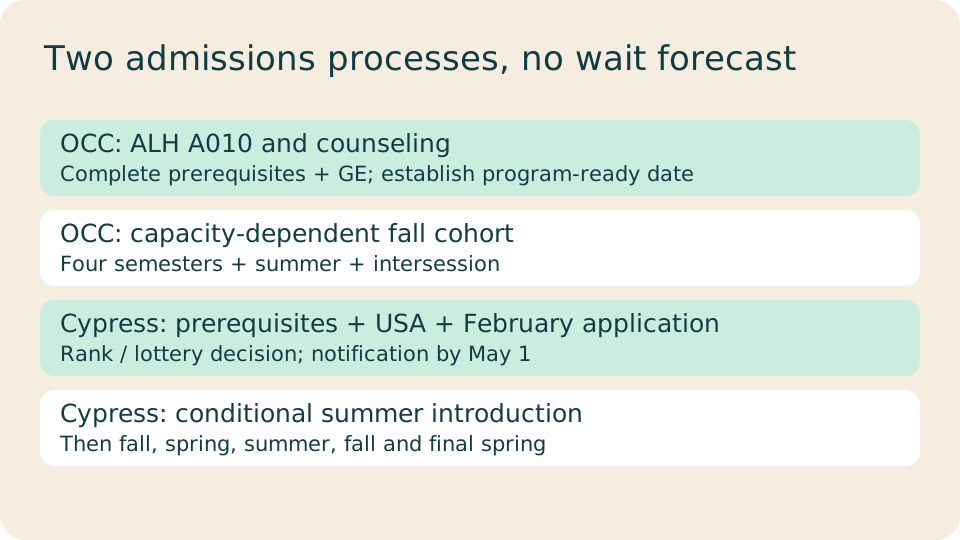
OCC asks students to complete the college/Allied Health process, take ALH A010 and establish program readiness. Its program starts a fall cohort annually and publishes a maximum twenty-four seats contingent on clinical capacity. The retrieved sources do not publish a trustworthy current wait length, the number of ready applicants ahead of a particular person or a future seat date. First-come/first-served does not mean immediate entry, and completing all courses does not guarantee that capacity remains the same next year.
Cypress accepts online Health Science applications during February, with notification no later than May 1 under the current page. The next cycle's exact opening/closing timestamps must be confirmed from its current deadline notice; do not assume a February calendar description permits a late submission at any hour. An applicant not selected must reapply the following year. The published system does not promise automatic promotion or a fixed number of points merely for waiting.
On smaller screens, scroll the illustration sideways to read every label.
The Cypress application requires USA assessment evidence with a raw score above zero in each Physics, Clinical and Question Analysis section. The USA is described as an aptitude assessment of relevant capabilities, not a traditional memorized sonography-knowledge examination. Schedule and document it according to the current instructions. The rank points use the combined weighted score; the positive raw-section eligibility rule and the weighted admission score are not the same measure.
Cypress's 150-point rank system
| Category | Maximum | Current workshop documentation/interpretation |
|---|---|---|
| USA weighted score | 50 | Workshop says score maps directly to points; a score of 25 gives 25 points |
| Prerequisite GPA | 50 | 4.0 = 50; 3.5–3.9 = 40; 3.0–3.4 = 30; 2.5–2.9 = 20 |
| Direct hospital patient care | 20 | At least 200 documented hours within five years, with qualifying letter |
| Consecutive full-time college | 10 | Workshop describes 12 hours for two consecutive semesters or six consecutive quarters; confirm quarter wording |
| DMS 160 with B or better | 10 | Conditional access/timing must be understood |
| Customer service experience | 5 | At least 200 documented hours within five years, with qualifying letter |
| Additional criteria | 5 | One point per eligible documented item, capped at five |
| Total | 150 | Rank-list position depends on all eligible applicants, not the maximum alone |
The current rank list fills about eighty-five percent of the cohort and the lottery fills about fifteen percent. Ties use prerequisite GPA, then combined USA score, then random selection under the current application/workshop language. The older information page's prior-application points and timestamp tie-break should not be substituted into this newer system. Public sources do not provide verified historical admitted cutoffs, the number of applicants at each score or a personal probability of selection.
An original scoring example: a hypothetical applicant has a USA weighted score of 34, a prerequisite GPA of 3.6, qualifying hospital care, consecutive full-time study, no completed DMS 160, qualifying customer service and three additional documented items. The arithmetic is 34 + 40 + 20 + 10 + 0 + 5 + 3 = 112 points. That number demonstrates the categories; it is not a forecast that 112 will earn a seat. A first-time applicant's inability to take DMS 160 openly should not be erased from the example.
Another hypothetical applicant with USA 28, GPA 3.2, no qualifying hospital care, qualifying full-time study, no DMS 160, customer service and five additional items would total 28 + 30 + 0 + 10 + 0 + 5 + 5 = 78. That applicant might explore legitimate documented criteria but cannot assume that unrelated volunteering counts as direct hospital patient-care employment or that retaking a passed course is allowed. Neither example establishes lottery eligibility because the college sources disagree about that separately.
Lottery conflict: confirm before relying on eligibility
The application page lists prerequisite GPA at least 3.0, hospital patient-care experience or USA score at least 30, consecutive full-time college, and customer-service experience. The workshop instead lists GPA at least 3.0, hospital patient-care or customer-service experience, USA at least 30, and full-time college. Those conjunctions differ. An applicant who meets one version but not the other should ask the Health Science office which rule governs the next cycle. This guide does not invent a merged rule or advertise a guaranteed lottery chance.
Experience letters and additional criteria
Experience letters should follow the workshop's required format: organizational letterhead and original signature, matching applicant name, start/end dates if applicable, full/part-time status, weekly or total hours, title/department and examples of duties involving patient interaction or customer service. A paycheck alone is not the described experience letter. Ask the office about electronic signatures and the actual upload format instead of assuming that a résumé proves the required hours.
Additional criteria include documented patient-care degrees/certificates, qualifying language proficiency/coursework, specified life circumstances and listed student-success courses. Each eligible item is one point, capped at five. Language options are bounded by the workshop list and documentation; a native-speaker paragraph is described for relevant proficiency. Do not turn this into a broad claim that every bilingual applicant automatically receives five points.
The workshop lists circumstances such as documented disability, qualifying aid/low income, first-generation status, employment during prerequisites, disadvantaged environment/EOPS, refugee status, veteran status and specified veteran-spouse circumstances. It also identifies acceptable supporting evidence and warns against inappropriate substitutes in some categories. These documents can be sensitive. Submit only through the college's process, redact only as allowed, and do not send financial, immigration or disability records to an unofficial preparation provider to “calculate your score.”
Student-success categories include specified higher math, study skills, career exploration, stress/anxiety management, interpersonal communication and critical thinking. Courses already used for prerequisite/GE requirements cannot simply be reused for additional points under the workshop instruction. Build a documentation checklist early, but do not take speculative extra classes solely because someone claims a hidden admission bonus. Ask for a counselor's review of the actual eligible items.
Curriculum and Clinical Sequencing
OCC publishes twenty-two months after cohort start, including four semesters, summer and intersession. That is not the time from a new applicant's first college class to graduation. Prerequisite/GE completion and an unpublished capacity-dependent interval come before the restricted sequence. The degree catalog's three-year-looking map includes preparatory coursework before the approximately twenty-two-month cohort phase.
| OCC phase in the current catalog map | Courses and listed units | Clinical/contact information |
|---|---|---|
| Preparatory year | ALH 010/111, BIOL 221, DMS 110, RADT 100, math and GE | Course access and counselor readiness review |
| Cohort first fall | ALH 115 (2), ALH 120 (2), DMS 123 (4), DMS 150 (3.5) | Patient care, sectional anatomy and physics foundations |
| Cohort first spring | DMS 126 (4), 155 (2.5), 161 (3), 165 (3), 166 (2) | Clinical 1 catalog contact: 108 hours |
| Summer | DMS 167 (5.5) | Clinical 2: 297 hours |
| Second fall / associated intersession sequence | DMS 255 (2.5), 271 (9), 274 (3), 276 (2.5) | Clinical 3: 486 hours; clinical 4: 135 hours; confirm actual intersession dates |
| Final spring | DMS 275 (3), 281 (10) | Review and clinical 5: 540 hours |
OCC's five clinical-course contact totals sum to 1,566 hours, using the catalog's 108 + 297 + 486 + 135 + 540. That is a sum of published course contacts, not a promise that every assigned week has the same number of shifts, and it is not a substitute for the actual cohort timetable. Additional scanning labs and classroom work are separate. The public sources retrieved do not give a definitive week-by-week clinical schedule; ask the program for the current schedule before committing to employment.
| Cypress phase | Current application-page sequence | Published externship/clinical weekly hours |
|---|---|---|
| Conditional summer before fall | DMS 160 Introduction (2 units) for accepted/alternate students | Confirm course meeting schedule and completion policy |
| First fall, 19 units | DMS 170 (3.5), 172 (5), 175 (4), RADT 262 (1), HS 98 (4), HS 165 (1.5) | DMS 172: 16 hours/week |
| First spring, 19 units | DMS 186 (4), 176 (3), 207 (8), HS 98 (4) | DMS 207: 24 hours/week |
| Summer, 8.5 units | DMS 188 (1.5), 217 (7) | DMS 217: 32 hours/week |
| Second fall, 15 units | DMS 195 (4), 227 (11) | DMS 227: 32 hours/week |
| Final spring, 13.5 units | DMS 210 (2.5), 237 (11) | DMS 237: 32 hours/week |
Cypress's five published phases total 75 units, plus the two-unit conditional introduction, before separately counted prerequisite/GE work. RADT 262 and HS 165 may be completed before cohort enrollment under the page note, which can reduce concurrent workload but does not erase their unit costs if newly taken. The college says courses must be completed in sequence and a minimum C is required to continue/successfully complete the program. A later clinical course is not an interchangeable elective that can be rearranged around a job.
Weekly commitment and employment feasibility
At Cypress, the published clinical commitment grows from sixteen to twenty-four and then thirty-two hours weekly. Those figures do not include lectures, scan labs, commuting, homework or preparation. A later week with thirty-two clinical hours plus class and travel can approach a full-time workweek before independent study. OCC likewise describes full-time, in-person training and publishes substantial clinical contacts. Neither route should be budgeted as a few evening classes around unrestricted full-time employment.
An illustrative planning week—not a school timetable—might reserve thirty-two clinical hours, six to ten class/lab hours, six to ten study hours and five to eight travel hours. That is forty-nine to sixty hours of commitment. Real schedules may differ, but the example shows why living at home does not automatically make a forty-hour outside job feasible. Ask about exact meeting days, early start times, attendance, make-up policies, finals and clinical travel before deciding how much employment to retain.
Clinical learning is supervised patient care, not ordinary paid employment. Do not build a budget that assumes clinical hours will produce wages. Ask the program about attendance/clearance requirements and site assignment boundaries. The retrieved current sources do not verify a complete named clinical-affiliation list or promise placement at a particular hospital. Having your own transportation is required, and a campus ten minutes from home does not guarantee an equally short clinical commute.
Clearances, Physical Demands and Progression
OCC describes background screening, drug screening, LiveScan, physical/health requirements, CPR/HIPAA/bloodborne-pathogen training in the relevant preparation, liability insurance, dress and identification requirements. The general Allied Health catalog emphasizes transportation and clinical clearance. Cypress lists background, physical/flu requirements, site-dependent drug screening, liability and personal health insurance, COVID vaccination and a current AHA BLS card on its current application page. Confirm current health/site policies because clearance requirements can change.
Clearance is not identical to ARDMS eligibility or a future employer's onboarding. A student may have an issue that must be evaluated at more than one stage. Use the official disclosure/evaluation process rather than assuming college acceptance guarantees national certification or site access. Do not post personal background information publicly to ask whether it will “probably be fine.”
Sonography also has real physical demands: positioning equipment and patients, sustained scanning, visual analysis, fine control and safe ergonomic technique. The OCC page describes functional demands including lifting/pushing/pulling and coordinated scanning tasks. Discuss accommodations through the proper disability/access process; do not infer that every applicant with a limitation is categorically excluded or that an online course can replace required patient-care competency.
Program progression rules matter financially. A nonpassing clinical or didactic course can interrupt a prescribed sequence, and a withdrawal is not necessarily repaired by joining the next class immediately. OCC's catalog distinguishes reasons for termination/readmission and specifically treats unsafe/substandard clinical performance differently. Cypress describes minimum grades and sequential progression. Ask about the actual readmission policy instead of assuming a paid tuition receipt reserves indefinite clinical capacity.
Living-at-Home Cost Scenarios With Explicit Assumptions
The most defensible comparison separates published charges, illustrative allowances and unknown items. OCC publishes an approximate $6,000 program figure without a complete individualized line-item breakdown. Both colleges publish a California-resident enrollment rate of $46 per unit. Cypress also publishes current health/transportation/parking charges. None of these numbers alone includes every prerequisite, meal, car repair, health premium, lost wage or national exam.
| Cost item | Verified basis or assumption | How to use it |
|---|---|---|
| Resident enrollment | $46/unit published by both colleges | Multiply newly required units, not all units previously completed |
| OCC program estimate | Approximately $6,000 on current program page | Treat as a planning baseline; ask what supplies/fees it includes before adding them again |
| Cypress cohort units | 75 in published phases plus 2 introduction = 77 | 77 × $46 = $3,542 enrollment if all are newly taken |
| Cypress health | $28 each semester; $23 summer | Use actual enrollment terms; six-term example below is an assumption |
| Cypress transportation | $3.76 full-time; $2.76 part-time on fee page | Apply actual status and terms, not one universal total |
| Cypress parking | $40 automobile permit; eligible waiver rate differs | Confirm current term/application; campus permit does not guarantee a space or clinical parking |
| National examinations | SPI $275; AB/OB/GYN $300 each | $575 for SPI plus one specialty; $875 for SPI plus both, before possible extra fees/retakes |
| USA, books, clearances, supplies | Actual invoices not verified as a complete current package | Use separately labeled allowances and obtain quotes |
California residency and fee-waiver eligibility must be determined by the college. Cypress currently lists nonresident tuition of $396 plus a $25 capital-outlay amount per unit in addition to the enrollment fee. A resident calculation cannot be advertised as the cost for every student. Financial aid or a fee waiver may reduce eligible charges but does not automatically pay commuting or replace lost wages. Resolve residency and aid status before treating any scenario as a personal budget.
Scenario A: OCC, resident student, living at home
Assumptions: thirty newly required prerequisite/GE units, $46 enrollment per unit, a $6,000 cohort planning baseline, twenty-two months of household contribution at $250/month, and a thirty-mile round-trip on four travel days per week for eighty weeks. These are planning assumptions, not an OCC timetable, an official average commute or a verified total-cost quote. We do not add a second full cohort enrollment charge on top of the approximate $6,000 because its included components are not fully itemized.
| Scenario A line | Calculation | Amount |
|---|---|---|
| Preparatory enrollment allowance | 30 × $46 | $1,380 |
| Preparatory books/material allowance | Assumed | $500 |
| Published cohort planning baseline | Approximate program figure | $6,000 |
| Household contribution | 22 × $250 | $5,500 |
| Commuting allowance | 30 miles × 4 × 80 × $0.25 | $2,400 |
| Parking/clearance contingency | Assumed pending included-item clarification | $800 |
| SPI plus AB exam | $275 + $300 | $575 |
| Total modeled cash need | Sum above | $17,155 |
The twenty-five-cent mileage allowance is a chosen marginal cash-cost proxy, not an IRS rate or the full ownership/depreciation cost of a vehicle. The contingency is not a published school fee. Personal health insurance premiums, major car repair, debt interest, lost income and any retake remain outside this total. If the $6,000 includes a contingency item, remove the duplicate. If a student already has fifteen of the modeled preparatory units, the enrollment allowance falls by $690; do not subtract tuition for credits that were never part of the assumed new-unit total.
Scenario B: Cypress, resident student, living at home
Assumptions: forty-one newly required prerequisite/GE units, all seventy-seven introduction/cohort units, four full semesters and two summer enrollments for the cohort-phase fee illustration, twenty-two months of household contribution at $250, and the same modest commute as Scenario A. Actual English/math choices, prior-degree waivers and courses completed early can change units and concurrent enrollment. An allowance is used for USA/books/supplies/clearances because a complete verified invoice package was not available.
| Scenario B line | Calculation | Amount |
|---|---|---|
| Preparatory enrollment | 41 × $46 | $1,886 |
| Introduction/cohort enrollment | 77 × $46 | $3,542 |
| Cohort health-fee model | 4 × $28 + 2 × $23 | $158 |
| Full-time transportation model | 6 × $3.76 | $22.56 |
| Campus parking model | 6 × $40 | $240 |
| USA/books/supplies/clearance allowance | Assumed, not an official package | $2,000 |
| Household contribution | 22 × $250 | $5,500 |
| Commuting allowance | 30 × 4 × 80 × $0.25 | $2,400 |
| SPI plus AB exam | $275 + $300 | $575 |
| Total modeled cash need | Sum above | $16,323.56 |
This model excludes preparatory-term miscellaneous fees, student-representation/ID charges, individual insurance, lost wages and debt interest. It uses twenty-two budget months for comparability, not as a newly claimed official Cypress duration. It is not proof that Cypress is precisely $831.44 cheaper: the OCC baseline is approximate, and the Cypress supply allowance is not an invoice. The comparison's value is the explicit structure, which lets you replace assumptions with your actual plan.
Scenario C: longer clinical travel or greater household support
If the round trip is sixty instead of thirty miles under the same eighty-week/four-day/$0.25 assumptions, commuting rises from $2,400 to $4,800, adding $2,400 to either model. If household contribution is $500 instead of $250 for twenty-two months, add $5,500. Together those choices add $7,900, giving an OCC model of $25,055 and Cypress model of $24,223.56, before the same excluded items. No clinical assignment is promised by either distance assumption.
Living at home can substantially reduce market rent while still leaving household costs. A realistic plan may include groceries, utility contribution, childcare and transport rather than pretending all living costs are zero. If family support is uncertain, build a backup reserve. An unpublished wait interval may add preparatory-course recency costs or delay income; because no verified wait duration is available, this guide does not insert a guessed two- or five-year wait into the totals.
Opportunity cost and examination choices
Original opportunity-cost example: reducing paid work by fifteen hours weekly for eighty weeks at an assumed $20/hour reduces gross earnings by $24,000. That is a hypothetical arithmetic example, not a regional wage statistic or guaranteed loss. Taxes, benefits and scheduling affect the real outcome. It explains why small tuition differences can matter less than work feasibility, household support and clinical travel.
Budgeting SPI plus both AB and OB/GYN requires $875 in current exam fees rather than $575 for one specialty pairing, a $300 difference before extra fees or retakes. Do not assume the college's approximate cost includes every national exam. Passing both may fit career goals, but no article can promise the employer demand or salary return for a particular combination. Choose the examination plan with the program's guidance and your intended work.
A Practical Decision Checklist
Start with a transcript review at each college. Ask which prerequisites and GE areas are already met, which local courses remain, whether laboratory delivery is acceptable, how course recency applies and what grade requirements govern the intended application/cohort year. Obtain the documented plan rather than making a spreadsheet from titles alone. Keep the two institutions' course codes and rules separate.
Next, compare the admissions processes honestly. At OCC, establish ALH A010/application steps and the program-ready date. At Cypress, complete the USA requirement, compute documented points, resolve lottery and DMS 160 conflicts, and confirm February deadlines. Neither a maximum possible score nor a completed ready checklist supplies a personal admission probability. A backup educational plan is reasonable, but a predicted cutoff from social media is not verified evidence.
Then compare real weekly logistics. Request current course/clinical meeting schedules, placement travel expectations, attendance and make-up policies, clearance deadlines and progression/readmission rules. Discuss childcare and work coverage before the thirty-two-hour clinical phase. It may be sensible to favor the program that fits sustainable logistics even if another program's tuition appears slightly lower under assumptions.
Finally, replace every budget allowance with a quote or personal figure. Confirm what OCC's approximate program total includes. At Cypress, calculate units actually needed, current term fees, USA cost, materials and clearances. Add personal transport, household contribution, insurance and an emergency reserve. Keep national examination and annual credential-maintenance costs separate from graduation tuition. Financial aid should be evaluated on actual eligibility, not an assumed award.
| Before deciding | OCC question | Cypress question |
|---|---|---|
| Coursework | How do current B/lab/three-year rules apply to my exact transcript? | What are the approved English/math units and equivalencies for my catalog rights? |
| Admissions | What is my documented program-ready date and what information about capacity is available? | Which lottery rule controls, and which documented points count this cycle? |
| Conditional course | Which cohort-restricted supporting courses may I take early? | What is the current DMS 160 B/W/nonrepeatability policy? |
| Clinical | What is the current weekly/intercession schedule and travel range? | What class/lab commitments accompany 16/24/32 clinical hours? |
| Costs | What exactly is included in approximately $6,000? | What are the current USA, supply, clearance and insurance invoices? |
| Outcomes | Where are current public completion/credential outcomes reported? | Where are current public completion/credential outcomes reported? |
Frequently Asked Questions
Which program is easier to enter?
The verified sources do not establish comparable acceptance odds or current wait times. OCC uses readiness-order admissions subject to capacity; Cypress uses points plus a limited lottery. Your completed coursework, documented experience and timing affect each differently. A published maximum of twenty-four OCC spaces is not an acceptance percentage without a compatible applicant denominator.
Can I apply to both?
The public information does not prohibit comparing both routes, but you must satisfy each college's separate application, local-course and documentation rules. Do not assume OCC ALH A010 or DMS A110 replaces Cypress's conditional DMS 160. Manage deadlines and financial commitments independently, and ask each office about any acceptance-response obligation.
Does a bachelor's degree remove all prerequisites?
No. Cypress lists possible GE waivers for an accredited U.S. associate degree or higher, but that does not erase program-specific prerequisites. OCC requires evaluation under its degree/admission rules. A bachelor's degree can also relate to a separate ARDMS eligibility pathway, but it does not by itself substitute for required clinical training or guarantee admission to either college.
Does OCC accept an online anatomy lab?
The current DMS program page requires an in-person anatomy lab and describes an A220/B-or-better alternative for certain prior A221 circumstances. Have the college evaluate the actual course and laboratory delivery. Do not interpret acceptance of an online lecture as acceptance of an online lab, or assume that another school's course automatically satisfies the alternative.
Can I improve Cypress points by repeating a passed prerequisite?
The current sources say a course cannot be repeated for a better grade once a passing grade is achieved. Ask about your specific transcript rather than building a plan on an assumed exception. Legitimate additional documented criteria may change points, but first-time course-access and eligibility rules still apply.
Is Cypress's lottery a chance for every eligible applicant?
No. It has separately stated eligibility requirements, and the current application page and workshop differ in their exact logic. Confirm the governing version with the office. Fifteen percent is a share of cohort allocation, not a fifteen-percent individual acceptance probability. The number of eligible lottery applicants is not published in the retrieved sources.
Can I take DMS 160 before applying?
Cypress describes it as a summer course for accepted and alternate students before the next fall. Its ten-point category does not mean it is openly available to every prospective applicant. Clarify how a prior alternate's completion is treated and the current B/withdrawal/nonrepeatability policy before relying on the course.
Will I know my clinical hospital in advance?
Neither retrieved current source establishes a guaranteed named assignment for an individual applicant. Clinical capacity affects enrollment and placement. Ask about current partner availability and assignment practices without treating a historical affiliation or a friend’s placement as a promise. Budget travel flexibility rather than campus distance alone.
Can I work full-time during the program?
The sequences include substantial clinical, classroom and lab demands. Cypress publishes up to thirty-two clinical hours weekly before other obligations; OCC describes full-time in-person training. A limited flexible job may fit some situations, but unrestricted forty-hour employment should not be assumed feasible. Obtain the current timetable and assess your own responsibilities.
Does graduation automatically confer RDMS or RVT?
No. Qualifying program completion can support the appropriate ARDMS pathway, but examination, documentation and pairing requirements remain. Introductory vascular classes do not establish a separately accredited vascular concentration or automatic RVT eligibility in every circumstance. Certification also does not automatically grant state licensure or employer procedural privileges.
What information remains unavailable?
No verified current wait-length distribution, admitted-point cutoff history, individual selection probability, complete named clinical-affiliation list or guaranteed placement was available in the retrieved sources. The public Cypress pages have unresolved lottery, introduction-course and some units discrepancies. OCC's program total is approximate and not fully itemized. These gaps are decision questions for the colleges, not invitations to invent numbers.
Conclusion and Next Steps
Both programs offer independently verified accredited abdominal-extended and OB/GYN training routes, but the practical decision depends on the exact transcript, readiness/selection process, weekly clinical demands and finances. Begin with the official application and counseling links in the sources, then build a documented plan for each. For national examination preparation, continue to AB, OB/GYN and SPI, or browse all preparation areas. Choose a sustainable verified route, not an unsupported promise of immediate admission or guaranteed employment.
Sources & Further Reading
- OCC DMS program: current grades, admissions, length and estimate; checked October 13, 2026 — Orange Coast College
- 2026–2027 OCC DMS A.S. curriculum and sequence — Coast Community College District
- Allied Health admission: program-ready order and three-year recency — Coast Community College District
- OCC 2026–2027 A.S. general education pattern — Coast Community College District
- OCC resident enrollment rate — Orange Coast College
- Cypress current application requirements and curriculum — Cypress College
- Cypress workshop: scoring and documentation, including conflicts noted in this guide — Cypress College
- Cypress program information page: older selection language, not the controlling current score system — Cypress College
- Cypress official enrollment, health and parking fees — Cypress College
- CAAHEP directory: current DMS program/concentration listings independently checked October 13, 2026 — CAAHEP
- ARDMS Pathway 2 and alternative examination prerequisites — Inteleos / ARDMS
- Current examination fees used in the illustrative budget — Inteleos
Related Posts
- Sonography Schools and AI Board Prep
- Sonography Student to RDMS: Year One
- ARDMS Pediatric Sonography Guide
If you find this article helpful and want to put the strategies into practice, sign up for an Ultrasound Analytics account to access the full ARDMS-aligned question bank, AI tutoring on every missed answer, full-length timed exams, and the analytics dashboard that translates your performance into a Readiness Score for each specialty registration.