
ARDMS Credentials and Maintenance
Published
ARDMS: What the Organization Does and Why It Matters
The American Registry for Diagnostic Medical Sonography, or ARDMS, is a certification organization for ultrasound professionals. It is not your college, an employer, a medical licensing board or the company that sells your study questions. Understanding those distinctions makes a career plan much easier: a program teaches and evaluates clinical skills, a credentialing body assesses defined competencies, a state may separately regulate legal practice, and an employer decides what responsibilities and privileges a particular role requires. One certificate does not automatically complete all four steps.
This guide explains the ultrasound credential families, how examinations and eligibility fit together, and what an active certificant must maintain after passing. Official pages and linked documents were checked on October 13, 2026. Current ARDMS resources are now on the Inteleos website, and the current account destination is the Inteleos portal. Old bookmarks, older handbooks and remembered renewal rules may no longer describe the applicable process. Where current public sources disagree, this article identifies the conflict rather than pretending that an older instruction is automatically safe to follow.
For readers preparing now, the largest maintenance change is not merely a new website. The current policy combines annual renewal and attestation, three-year CME requirements, and annual specialty-specific Knowledge Confirmation through SKILLS. The detailed FAQ changes the CME total for the ultrasound credentials covered here and explains an exception for the legacy Neurosonology specialty. It also clarifies the consequences of not completing the yearly questions. A tenured registrant should not assume that longevity exempts them.
This is an educational navigation guide, not an eligibility decision, legal opinion or account-specific maintenance determination. Your portal, applicable policies and written clarification from the responsible organization control your own requirements. We do not access anyone's account, invent qualifications for our byline, or promise that certification guarantees employment, a salary or a state license.
Contents and a Career-Stage Reading Map
History and governance · Credential families · Eligibility · Licensure · Annual renewal · CME · SKILLS · Checklists
| Reader | Start with | Decision to make |
|---|---|---|
| Prospective student | Program accreditation, eligibility pathways and credential families | Does this educational route support the examinations needed for the intended work? |
| Current student | SPI/specialty pairing, application documents and calendar | Which application pathway and timing actually apply? |
| Newly credentialed sonographer | Annual renewal, CME cycle and SKILLS start year | What is due now, and what begins in the next full year? |
| Multi-specialty registrant | Specialty-by-specialty SKILLS and portal CME requirement | Which designations will remain active, with what obligations? |
| Traveler or relocating professional | State board scope and employer requirements | What authorization and onboarding must be complete before work begins? |
| Returning or retiring professional | Status, reinstatement and current written rules | Is active practice/credential use permitted, and what restoration process applies? |
History and Governance
The official ARDMS community page dates the organization's work to 1975. Its stated focus is professional excellence in sonography, patient safety and assessments developed with the profession. That origin helps explain why registrants commonly identify themselves with ARDMS even though current web pages, policies and the portal use Inteleos branding. A redirect is not evidence that your RDMS or RVT designation has been replaced with a new credential.
Inteleos governs and manages ARDMS alongside other member communities, including APCA and the POCUS Certification Academy; its foundation supports philanthropic work. This article is limited to ultrasound credentialing relevant to the sonography audience. Other services under the same umbrella do not imply that every examination follows the same eligibility, scoring, calendar or maintenance rules. Follow the individual credential's policy rather than transferring an unrelated physician-certification rule into an ARDMS application.
| Milestone | Verified interpretation | What not to infer |
|---|---|---|
| 1975 | ARDMS identifies this as the start of its sonography certification history | It does not establish the launch year of every later specialty |
| Fifty-plus years of operation | Current community page describes a longstanding professional certification role | Longevity does not exempt an active registrant from current maintenance |
| Current Inteleos structure | Inteleos governs/manages ARDMS and other member communities | Inteleos-wide population totals are not ARDMS-only counts |
| 2026 ultrasound maintenance transition | Annual SKILLS obligations and the revised CME total are described in the current detailed FAQ | Older thirty-credit or periodic-exam summaries may not apply to the current cycle |
| Announced January 2027 NE sunset | Current FAQ states the legacy Neurosonology specialty will no longer appear as active | This is a specific announced exception, not a forecast for other specialties |
Certification organizations use governance, policies, subject-matter expertise and psychometric processes to maintain a defensible assessment. The current pages describe certification accreditation under ANSI/ISO/IEC 17024 through ANAB. That accreditation concerns the certification process. It is separate from CAAHEP program accreditation, which concerns a particular educational program and concentration. A school can have institutional accreditation without its sonography program holding the relevant programmatic accreditation.
The distinction matters in everyday language. Saying “an ARDMS-accredited college” collapses two organizations with different jobs. Ask instead whether the program is currently accredited by CAAHEP in the relevant concentration and whether your completion/documentation satisfies an ARDMS prerequisite pathway. Similarly, a training vendor being helpful does not mean that it administers the official exam or can approve an applicant.
Ultrasound Credential Families
ARDMS currently describes four credential families: RDMS, RDCS, RVT and RMSKS. The letters identify a professional credential; specialty designations identify areas within the relevant framework. Passing SPI is a shared examination result, not a fifth credential family. Avoid writing “SPI registered” as if it were the equivalent of holding RDMS or RVT.
| Credential family | Meaning | Ultrasound examination relationship |
|---|---|---|
| RDMS | Registered Diagnostic Medical Sonographer | SPI plus an eligible diagnostic-medical specialty such as AB, BR, OB/GYN, PS or the applicable FE pathway |
| RDCS | Registered Diagnostic Cardiac Sonographer | SPI plus an eligible cardiac specialty; FE may support RDCS as described in its pathway |
| RVT | Registered Vascular Technologist | SPI plus Vascular Technology under the applicable prerequisite and pairing rules |
| RMSKS | Registered Musculoskeletal Sonographer | Separate musculoskeletal examination/prerequisite framework; do not assume the RDMS SPI pairing is universal |
| SPI passed examination | Sonography Principles and Instrumentation | Shared principles/instrumentation result; no standalone SPI credential or credential-holder count |
FE is a useful example of why examination names and credential families must be separated. A fetal-cardiac examination can support an RDMS or RDCS route, depending on the applicable choice and requirements. Pediatric Sonography is not Pediatric Echocardiography. Someone working in vascular studies may seek RVT even if they already hold RDMS in another area. Clinical overlap does not make the examinations interchangeable.
The common SPI/specialty relationship for RDMS, RDCS and RVT uses a five-year pairing rule, and either exam may be taken first when eligibility allows. Maintain current active status and verify the additional-specialty process when expanding. Do not assume every added specialty requires retaking SPI, or that an old SPI pass outside the applicable timeframe always remains usable for a first credential. A passed examination result, an active credential and an expired/revoked status are different facts.
Official examination and outline directory
| Preparation area | Official exam page and linked full outline | Our detailed guide |
|---|---|---|
| AB | Abdomen | AB guide |
| BR | Breast | BR guide and December 2026 transition |
| FE | Fetal Echocardiography | FE guide |
| OB/GYN | Obstetrics and Gynecology | OB/GYN guide |
| PS | Pediatric Sonography | PS guide |
| VT | Vascular Technology | VT/RVT guide |
| SPI | Sonography Principles and Instrumentation | Shared principles guide |
Each official exam page links its current full outline. Open the complete linked document, not only the summary weights. Check effective dates: BR has a newly published outline for testing beginning December 16, 2026, while the earlier outline still applies before that date. A PDF existing on a website does not automatically mean it is already the governing version for your appointment.
Eligibility Pathways and Application Documents
ARDMS does not have one universal “graduate from a CAAHEP school or you cannot apply” rule. The August 2026 prerequisite document describes several routes, each with specific education, experience and documentation. Choose one complete applicable pathway rather than mixing the easiest pieces of several. A college's admissions prerequisites are not the same as the certification body's examination prerequisites.
| Pathway | Core idea | Important limit |
|---|---|---|
| SPI early entry | Qualifying graded physics education or qualifying recent accepted physics CME | Approval is for SPI only; it does not establish specialty eligibility |
| 1: allied health | Qualifying two-year patient-care allied-health education plus specified clinical experience | DMS/CVT education used here has additional outside-program experience requirements |
| 2: accredited program | Qualifying programmatic-accreditation route with director/completion documentation | Accreditation is not retroactive; pregraduation paperless approval depends on completing the program |
| 3A: bachelor's | Bachelor's education plus specified ultrasound/vascular experience | Degree alone is not sufficient |
| 3B: sonography bachelor's | Specified sonography/vascular bachelor's or student route | Clinical completion and application-letter rules differ for students and graduates |
| 5: specified active credential | Listed qualifying CCI, ARRT or Sonography Canada credential | Only the specified active credentials qualify; clinical verification still matters |
| Physician pathway | Specified medical education/license and specialty study experience | Do not apply a physician route to a nonphysician applicant |
For Pathways 1 and 3A, the document defines experience through qualifying employment or education and describes at least twelve months and 1,680 hours, with rules about appropriate settings, completion and non-overlap. Part-time work is prorated. Volunteer, barter, veterinary and nondiagnostic keepsake scanning are not acceptable substitutes. A program that extends beyond twelve months must be completed in its entirety for the education-based route. These details can change whether an apparently adequate résumé actually meets the policy.
Pathway 2 graduates applying within a year of successful completion have specific exceptions to separate Clinical Verification requirements; after that period, updated documentation may be needed for each specialty. Eligible students using a program director's paperless process can apply up to sixty days before graduation. Their results depend on finishing the program. A student who leaves without successful completion cannot assume that a passed pregraduation examination remains valid.
SPI early entry normally requires an appropriate physics course with C or better, or twelve accepted physics CME credits earned within two years, with the specified transcript/certificate information. It does not require the same Clinical Verification form as a specialty application. If an applicant already satisfies a full pathway, the prerequisite document recommends considering that route because it can simplify later processing. The correct choice is the one the documents establish, not the one a study service guesses from a short chat.
Names must match, foreign education may require course-by-course evaluation, and documents in another language require the specified translation. Keep copies of submissions and confirmation notices. Approval can be subject to a later documentation audit. If compliance history, a name change or an unusual educational route creates uncertainty, get formal guidance before paying travel expenses. Avoid sending sensitive documents to an unofficial preparation provider when they belong in the official portal.
How Examinations Are Designed, Scheduled and Scored
An examination outline reflects defined professional tasks, with domain weights and knowledge/skill expectations. Subject-matter experts contribute questions, and standardized assessment processes address the passing standard and scoring. It is reasonable to use practice questions to learn, but no legitimate preparation site can promise to supply the secure actual questions. Memorized recalled items undermine examination integrity and do not demonstrate adaptable competence.
The seven areas in this series differ in count, time and availability. SPI publishes approximately 110 questions in two hours. Specialty counts range from about 145 for FE to about 170 for several other areas, with three-hour specialty examinations. Some specialties include hotspot items as well as multiple choice. Tutorial, check-in, survey and answering time are not interchangeable. Arrive according to admission instructions and review the specific confirmation letter.
The common scaled-score range is 300–700 with a passing score of 555. That is not a raw percentage, and 555 divided by 700 is not a passing-percent formula. Form equating and the passing standard mean that a commercial quiz's percent correct cannot be converted directly into an official score. Use practice performance to identify learning needs and pacing, not to advertise certainty about passing.
The 2026 calendar lists AB, BR, OB/GYN, SPI and VT as year-round and FE/PS as windowed. Windowed examinations have separate application, registration, testing and score-release dates. On October 13, 2026, the published second FE and PS testing windows have already ended. Their score release can still be pending. A sixty-day retake interval does not produce a seat in a closed window or imply an immediate windowed score.
Fees in the current schedule are US$300 for the listed ARDMS specialties and US$275 for SPI, each including a US$100 nonrefundable processing portion; an additional US$50 international-center fee applies outside the United States, Canada and Mexico. Annual maintenance fees are a different charge. Cancellation and refund terms must be read separately. A retake ordinarily requires another application and payment, with reapplication after seventy-two hours and a minimum sixty days before taking the same exam again.
Interpreting statistics without overstating them
| 2025 examination | First-time attempts | Repeat attempts | All attempts |
|---|---|---|---|
| AB | 73% | 45% | 67% |
| BR | 77% | 49% | 71% |
| FE | 75% | 41% | 68% |
| OB/GYN | 80% | 50% | 75% |
| PS | 71% | 44% | 65% |
| SPI | 74% | 47% | 68% |
| VT | 70% | 45% | 63% |
Source: the 2025 global performance report, January 1–December 31, 2025. These denominators are attempts in each group. The report does not publish group counts in this table, so an overall result is not the arithmetic mean of the first-time and repeat percentages. The differences are descriptive and do not establish causes or individual acceptance/pass odds.
The current community page states 117,000+ ARDMS registrants, retrieved October 13, 2026, without a clearly labeled census date. Inteleos-wide numbers include other communities and must not be substituted. Credentials, specialty designations, unique people and test attempts are four different quantities. A person can hold RDMS and RVT and more than one RDMS specialty. Current auditable unique-person specialty counts were not available in the retrieved primary sources; no specialty percentage is calculated from incompatible denominators.
Certification Versus State Licensure
Certification demonstrates that an organization has recognized defined professional qualifications; state licensure grants legal authorization within a jurisdiction and scope. Employer onboarding and clinical privileges add another layer. An ARDMS pass does not automatically create a license. A traveling sonographer needs to check the destination state, professional scope, exemptions, credential status and employer requirements before accepting a start date.
The table below is intentionally limited to jurisdictions for which primary licensing materials were retrieved. It is not a fifty-state declaration that every other state has no requirement. Nor does it claim that all professionals using an ultrasound device fall under the same sonographer licensing category: licensed physicians and other regulated professionals may have different statutory scopes or exemptions. Use the board's actual category and current rules.
| State | Verified sonography-related framework | Practical next step and boundary |
|---|---|---|
| Oregon | Medical-imaging rules include diagnostic medical sonographer qualifications and recognized ARDMS/other credential routes | Apply through the Board of Medical Imaging; check the relevant scope and current credential/renewal requirements |
| New Hampshire | OPLC's sonographer document checklist requires an application, disclosures, prior-state verification, background process, education/resume and recognized certification evidence | Use the current OPLC sonographer category; do not assume the national card replaces approval |
| North Dakota | Administrative rules recognize sonography and modality-specific credential/education requirements, background checks and licensing procedures | Confirm the applicable primary modality and full/temporary/conditional route with the board |
| New Mexico | Current 20.3.20 NMAC rules include diagnostic sonography and subspecialties including cardiac/vascular ultrasound, with licensing separate from national credentials | Follow the MIRTP process and current rules; the older implementation FAQ's 2019 dates are historical, not current deadlines |
| Other states | Not individually verified for this article | Check the relevant state authority and employer; absence from this table is not a legal conclusion |
For Oregon, the Secretary of State rules distinguish qualifications, licensing and continuing education. For North Dakota, Chapter 114-02-01 describes primary modality requirements and special licensing routes. For New Hampshire, the official document checklist is a starting point, not the complete law. New Mexico's current 20.3.20 NMAC defines diagnostic sonography and its included cardiac, vascular and other subspecialties. Its MIRTP application website temporarily blocked our retrieval; the current rules were retrieved separately, and the older FAQ is used only for historical implementation context.
A useful relocation checklist asks whether the national credential is active, whether the state recognizes that credential for the requested scope, whether the application requires primary-source verification or background checks, whether practice may begin before approval, and when renewal/continuing education is due. Ask the board about your exact role rather than accepting a recruiter saying “ARDMS is enough everywhere.” Employer credentialing can be stricter than a legal minimum.
Annual Renewal Fees and Attestation
Annual renewal and attestation are due by December 31 under the current pages. The renewal process opens in September for the next year, and the fee payment includes a paperless attestation. A person earning their first certification in December has the published grace period through February 28 for that initial renewal circumstance. That exception is not a universal extension for every late payer.
The retrieved public annual-fee page does not present a reliably current dollar amount for every ARDMS account. We therefore do not repeat an older remembered amount as a verified 2026 charge. Check the actual renewal invoice and applicable credential combination in your portal. SKILLS has no additional platform/quiz fee, but that does not mean annual certification renewal is free. Examination, annual renewal, CME purchases and reinstatement are distinct budget lines.
| Annual action | What to verify | Why it matters |
|---|---|---|
| Contact/account review | Current email, access and held specialties | Notices cannot help if they go to an abandoned address |
| Renewal payment | Portal invoice, due year and confirmation | Paying an exam fee is not annual renewal |
| Attestation | Compliance with policies and applicable CME commitments | It is a professional declaration, not a marketing checkbox |
| SKILLS review | Every held specialty's annual completion and cumulative result | One specialty's successful dashboard does not satisfy another |
| Status check | Active directory status after renewal | A receipt, badge screenshot or old card does not substitute for current status |
Attestation includes a commitment to accrue the required CME by the end of the applicable cycle and to remain compliant with policies. The official page lists matters such as fraud or misrepresentation, professional discipline, certain criminal findings, impairment, cheating and failure to cooperate with an investigation. A reportable issue should follow the official disclosure process; it is not resolved by omitting it because a college admitted you or an employer did not ask.
Failure to meet renewal requirements can revoke certification status, and credential use must stop when it is no longer active. The public fee page includes cycle-specific reinstatement dates, including an August 1, 2026 reference. Do not carry that historical deadline into an unrelated later renewal year. Use your actual notice and current policy for deadlines, fees and restoration. Retired status is different from active practice, and the detailed FAQ says retired status does not permit use of credential designations as active certification.
Three-Year CME Cycles, Credits and Records
The most important current numerical distinction comes from the detailed MOC FAQ. For RDMS, RDCS, RVT and RMSKS, a cycle ending on or before December 31, 2025 required 30 CME credits. A cycle ending on or after December 31, 2026 requires 25 CME credits, and those credits do not need to be specialty-specific under that current FAQ. A general page saying “requirements vary; check your portal” does not justify perpetuating an older universal thirty-credit claim.
Your portal identifies the personal cycle dates and required total. Multiple credentials or status situations should be checked there rather than guessed by multiplying twenty-five by every specialty. Annual SKILLS questions are separate from the three-year CME total. Completing forty questions does not automatically mean you earned forty CME credits, and earning enough CME does not substitute for the annual Knowledge Confirmation requirement.
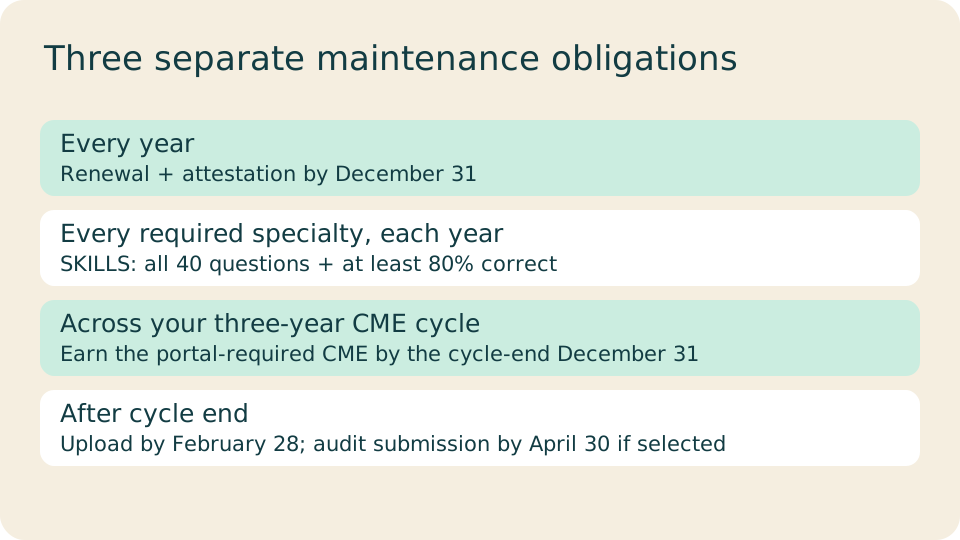
On smaller screens, scroll the illustration sideways to read every label.
A dated cycle example
Suppose a registrant's portal displays a January 1, 2024–December 31, 2026 cycle. The current FAQ's twenty-five-credit total applies to a cycle ending in 2026. Credits must be earned by December 31, 2026. The CME Bank page says to upload them by February 28, 2027, and the audit process begins in March 2027 for this ended cycle. Selected registrants have until April 30 to submit required documentation, with results in June. Upload timing does not grant extra time to earn ordinary cycle credits.
The example is useful because it separates five dates that are often conflated: course completion, cycle end, suggested/required bank upload timing, audit selection and audit submission. A credit earned after the ordinary cycle closes cannot simply be relabeled as a prior-year credit. The audit reinstatement process has a separate provision for deficiency remediation and its own fee and deadline; that is not a recommended routine extension of the CME cycle.
The general CME page describes waivers including fifteen credits for a new certification or specialty and volunteer-related reductions up to the published limit. These are waivers, not fabricated course certificates or automatic credits you can award yourself. Verify the reduction reflected in your account and the applicable rules. A reader with a portal total different from the ordinary total should reconcile the account with Inteleos rather than delete the discrepancy or assume the public article controls their personal cycle.
Accepted credit sources and documentation
Use the accepted-sponsors directory before purchasing an activity. A course being educational or “ultrasound related” is not enough to establish accepted credit. Check sponsor, credit designation, dates and certificate information. Keep completion certificates for at least the minimum four-year retention period stated in the current CME guidance, with a backup you can access if an employer email account closes.
The CME Tracker Program can transfer accepted records from participating organizations. The retrieved general page lists AIUM, ASE, ASRT A/A+, IAME, SDMS, SVU and Orbit-related arrangements. Membership/activity conditions and exact identifying information matter. Transfers can take up to three weeks. A mismatched name or identifier can leave an apparently completed course absent from the bank; inspect the account rather than waiting until an audit deadline to discover the gap.
Manual upload remains useful for accepted activities not transferred automatically and for earlier credits that need entry. Certificates should clearly support participant, activity, completion date, sponsor/provider and credit amount. The current guidance permits some participant information to be added by hand but says course dates, sponsor/provider and activity title must be preprinted. Do not alter the underlying course or claim credit that the certificate does not document.
CME Bank upload and status
Log into the current Inteleos portal and open the CME Bank. Review the displayed cycle and required total, enter the activity information as prompted, upload a legible certificate, and confirm that the record is associated with the intended dates. Then inspect the bank rather than assuming a successful file upload means the credit is already approved. Keep the original certificate and any confirmation locally.
The CME Bank page distinguishes approved transferred records from manually uploaded pending records. Pending credits can remain pending unless the certificant is selected for audit and they are reviewed. Pending does not necessarily mean rejected or that your upload failed. Conversely, a stored certificate is not a guarantee that an unacceptable activity will count when reviewed. The bank supports organization and audit; it does not change sponsor acceptance rules.
Audit, appeal and reinstatement
The audit process describes random selection after the prior December cycle end, notification through portal/email, April 30 documentation, and June results. Failure to submit the minimum accepted CME can revoke certifications. If an audit failure appears to be a recording error, the current page calls for a written explanation and proof within ten business days of the official failure notification.
Its reinstatement process requires documentation, handling of deficiencies as allowed, upload to the bank, the specified notification to the audit team and a US$150 reinstatement fee by the stated August 1 deadline. After that deadline, the page describes permanent revocation and the need to retake necessary examinations to regain active status. These are serious consequences; do not interpret an appeal email as permission to keep using an inactive credential while awaiting a decision.
SKILLS Knowledge Confirmation: Current Rules and Exceptions
For the RDMS, RDCS, RVT and RMSKS framework discussed here, current rules require four quarterly ten-question quizzes per specialty, totaling forty questions annually for each held specialty. Questions release on the first day of each quarter. All forty must be completed, and at least 80% correct cumulatively must be achieved by December 31. There is no separate platform or quiz fee. Individual quizzes are not described as a high-stakes pass/fail specialty examination.
Forty questions with an eighty-percent cumulative threshold means at least thirty-two correct responses across the complete annual set. A dashboard score based only on released questions earlier in the year is not a final annual outcome. Completing three quizzes with a good percentage does not satisfy the fourth quiz. Review every specialty individually because the current detailed FAQ says there is no combined all-specialties view.
| SKILLS rule | Current explanation | Common mistake |
|---|---|---|
| Enrollment/start | Knowledge Confirmation begins in the full year after the new specialty/certification is awarded | Starting the new specialty's obligation in the award month without checking its start year |
| Release | First day of each quarter | Assuming all future-year questions are available in January |
| Annual quantity | Four sets of ten per specialty | Counting forty total across several specialties |
| Annual standard | All forty answered and at least 80% cumulative by December 31 | Treating one strong quiz or partial-year percentage as complete |
| Platform | Browser or SKILLS app with synced progress | Assuming the portal itself displays all real-time quiz results |
| Responses | Submitted/skipped responses cannot be changed; skipped counts incorrect | Skipping as a harmless flag for later |
| Failure to meet requirement | Specialty/certification revocation and reinstatement process | Assuming low-stakes means optional |
A concrete start-year example from the official page: RDMS(AB) awarded in 2025 has its first AB quizzes due December 31, 2026. An OB specialty awarded in February 2026 begins its quizzes January 1, 2027, with the first OB deadline December 31, 2027. These obligations can therefore differ across specialties in the same account. Record each award year and check the dashboard for the correct set.
Resolving conflicting attempt instructions
The general SKILLS platform page describes unlimited attempts while also saying submitted or skipped responses cannot be changed. The current detailed MOC FAQ instead emphasizes explanations after an incorrect response, immutable submitted/skipped answers, and the cumulative annual standard. These statements are not safe grounds for promising unlimited annual quiz resets. This guide follows the more specific FAQ for the practical rule: read carefully before submitting, do not skip expecting to return, and ask SKILLS support about any uncertain platform behavior.
The platform provides explanations and resources after incorrect answers. Use them for learning, but do not claim that reading the explanation erases the recorded response. If the internet connection drops, the detailed FAQ says submitted questions are saved and the remaining questions can be resumed after sign-in. Technical problems should be reported through the SKILLS Support menu; keep only one browser tab/window open as recommended. A sixty-minute inactivity timeout described on the platform page is not a sixty-minute annual exam time limit.
Consequences, remediation and legacy exceptions
The detailed FAQ states that failing to complete the forty questions and meet the eighty-percent requirement for a specialty means its maintenance requirement is unmet; that specialty or certification will be revoked and a reinstatement process applies. The retrieved current public pages do not spell out a complete SKILLS-specific remediation schedule, extra-attempt entitlement or reinstatement dollar amount. Those details are therefore not invented here. Contact Inteleos promptly for the applicable written process and deadlines, especially before the December deadline, rather than borrowing the CME audit's August date for SKILLS.
The current FAQ says active tenured registrants are not excluded merely because of tenure. It separately excludes legacy Neurosonology from Knowledge Confirmation, describes continuation through 2026 under the stated prior-active/CME conditions, and announces a January 2027 sunset. That is a verified announced policy, not a generic exemption for all older specialties. Retired status has different responsibilities but does not authorize active credential designation use.
If you no longer practice a specialty, the FAQ describes allowing it to lapse while maintaining specialties for which all requirements are met; lapse means revocation of that specialty/certification. It also says additional retirement options are planned. A future option is not a currently available account action. Before intentionally abandoning quizzes, understand which credential remains supported by your other specialties and obtain account-specific clarification. Do not silently represent a lapsed designation as active.
Career-Stage Checklists and Common Mistakes
Before program enrollment, verify institutional and programmatic accreditation separately, the specific concentration and award, the intended eligibility route, clinical requirements, total cost and any state requirements for future practice. The Orange Coast versus Cypress comparison demonstrates this approach with two real public programs. A school having “ultrasound” in its name does not establish the required pathway.
Before exam application, collect transcripts, director letters or experience verification, the relevant CV form, name-change/equivalency documentation where needed, fees and a realistic calendar. Check the whole content outline and the testing-date version. Confirm approved eligibility before scheduling. After an unsuccessful attempt, plan around both the minimum retake wait and any window calendar; use the domain feedback to change preparation rather than simply repeating the same material.
After credential award, record the award date, active credential/specialty, renewal invoice, CME cycle and SKILLS start year. Inspect the official status directory rather than relying on a cached badge. Each year, keep an account review before the December deadline and another check after completion. In the cycle-ending year, separate credit earning from upload and audit timing. These are small administrative habits with professional consequences if ignored.
For multiple specialties, create a row per specialty with award year, SKILLS completion and cumulative score. Keep a separate CME-cycle record; do not automatically duplicate the ordinary total per specialty. If a specialty disappears from the platform or the displayed requirement seems wrong, contact support while there is time to resolve it. Completing whichever quiz is visible is not evidence that the missing specialty's obligation was satisfied.
For return to practice or retirement, confirm status first. Then verify any reinstatement/recertification route, state license, employer competency requirements and permissions. A retired or revoked national status cannot be described as currently active because the professional once passed the exam. A résumé can truthfully explain prior credential history while clearly distinguishing current authorization and active designations.
Frequently Asked Questions
Is ARDMS the same organization as Inteleos?
ARDMS is an Inteleos-governed member community. Current resources and account management use the Inteleos website/portal, while the professional credential names remain the relevant ARDMS designations. The umbrella also includes other communities, so use the rules for your actual credential rather than assuming every service has the same maintenance schedule.
Does SPI alone make me a registered sonographer?
No. SPI is a shared principles/instrumentation examination result. RDMS, RDCS and RVT require the applicable eligible specialty and pairing requirements. SPI early-entry approval does not establish specialty eligibility. RMSKS has a separate framework, so “every ARDMS credential is SPI plus one specialty” is also too broad.
Is CAAHEP graduation the only way to qualify?
No. It is an important programmatic-accreditation route under Pathway 2, but other published pathways address qualifying allied-health education/experience, bachelor's routes, specified credentials and physicians. Their documentation and experience requirements are specific. Read the actual current pathway rather than combining fragments or accepting a blanket guarantee from a training vendor.
Do I need twenty-five or thirty CME credits?
For RDMS, RDCS, RVT and RMSKS, the detailed current FAQ says thirty for cycles ending on/before December 31, 2025 and twenty-five for cycles ending on/after December 31, 2026. Check your portal for cycle dates, waivers and account-specific requirements. SKILLS remains separate. An older generic maintenance article should not override the newly published applicable transition.
Will my uploaded CME stay pending forever?
Manual records can remain pending unless selected for audit and reviewed, while tracker-transferred accepted records show approved under the bank guidance. Keep complete certificates, verify acceptance and upload by the stated timing. Pending does not necessarily mean rejected; stored does not necessarily mean accepted. Contact the CME team if dates, sponsor or account totals do not reconcile.
Can I skip SKILLS questions and answer them later?
The detailed FAQ says a skipped question counts incorrect and cannot be changed after skipping/submission. Do not treat skip as a harmless bookmark. Submitted progress can survive a connection failure, and remaining unanswered questions can be resumed. General language about unlimited attempts should not be read as guaranteed unlimited reset rights.
Do two specialties share one forty-question set?
No. The current framework assigns forty annual questions per specialty, with individual dashboard review. A new specialty begins in its next full year, so two held specialties may have different start years. The current FAQ says there is no combined all-specialties dashboard view. Verify completion and cumulative score for each required specialty.
Is there a grandfathered exemption for long-time registrants?
Not based solely on tenure under the current FAQ. Neurosonology has a specific legacy exception and announced sunset; it is not proof that other older specialties are optional. Retired status has different obligations but does not permit active credential designation use. Ask for the applicable account determination if a legacy situation is unclear.
Does national certification let me work in any state?
Not automatically. State licensure and employer requirements are separate. This article verifies primary materials for Oregon, New Hampshire, North Dakota and New Mexico but does not make a legal declaration about every other jurisdiction or every ultrasound-using profession. Confirm destination-state scope, application, exemptions and approval before starting work.
What future changes are actually confirmed?
The current sources confirm the BR blueprint effective December 16, 2026 and the detailed FAQ's NE sunset in January 2027. Inteleos also publishes a broad 2032 strategic vision and mentions future retirement options. A strategic vision is not a newly enacted exam, maintenance or employment rule. No unpublished launch date, exemption or additional credential is assumed here.
Conclusion and Next Steps
ARDMS certification is best understood as a continuing professional framework: eligibility, assessment, active status, learning and ethical compliance all matter. Start with the official certification finder and the relevant examination page, then use our seven preparation areas to build domain-level proficiency. Maintain a separate checklist for annual renewal, CME and each specialty's SKILLS requirement. Clear distinctions prevent a passed exam from being mistaken for a license, a course upload for accepted credit, or a partial-year quiz score for completed maintenance.
Sources & Further Reading
- Current official account portal — Inteleos
- AB official exam page and outline directory — Inteleos
- BR official exam page and outline directory — Inteleos
- FE official exam page and outline directory — Inteleos
- OB/GYN official exam page and outline directory — Inteleos
- PS official exam page and outline directory — Inteleos
- VT official exam page and outline directory — Inteleos
- SPI official exam page and outline directory — Inteleos
- ARDMS community, founding year and registrant statement; verified October 13, 2026 — Inteleos
- Inteleos governance and published strategic policy — Inteleos
- Certification/exam directory — Inteleos
- Current eligibility pathways, August 2026 — Inteleos
- 2025 examination performance — Inteleos
- Exam fees — Inteleos
- Exam calendar — Inteleos
- Maintenance: knowledge confirmation — Inteleos
- Maintenance: skills platform — Inteleos
- Maintenance: annual attestation — Inteleos
- Maintenance: annual renewal fee — Inteleos
- Maintenance: continuing medical education — Inteleos
- Current detailed MOC FAQ: CME transition, SKILLS consequences and legacy exceptions — Inteleos
- CME: cme bank — Inteleos
- CME: cme audit process — Inteleos
- CME: accepted sponsors — Inteleos
- Oregon sonographer qualifications and imaging rules — Oregon Secretary of State
- North Dakota modality and licensing requirements — North Dakota Legislative Branch
- New Hampshire required documents by license type — New Hampshire OPLC
- New Mexico medical imaging licensing program — New Mexico Environment Department
- Current New Mexico medical imaging rules, including diagnostic sonography scopes and licensing — New Mexico State Records Center and Archives
- New Mexico ultrasound licensure implementation FAQ; historical transition dates, not a current fee schedule — New Mexico Environment Department
- Current accredited program directory — CAAHEP
Related Posts
If you find this article helpful and want to put the strategies into practice, sign up for an Ultrasound Analytics account to access the full ARDMS-aligned question bank, AI tutoring on every missed answer, full-length timed exams, and the analytics dashboard that translates your performance into a Readiness Score for each specialty registration.